By now you’ve probably read about berberine, fiber, probiotics, green tea extract, and a handful of other supplements that may support GLP-1 naturally. Each one has its own evidence base and mechanism. But most people don’t take just one supplement — they want to know how to combine them intelligently, which ones are worth prioritizing, and which are probably not worth the money.
This article does exactly that. It’s a practical synthesis of the evidence across the full supplement category, organized by tier so you can build a stack that fits your goals, budget, and health situation. No padding, no hype — just the clearest picture the current research supports.
How to Think About a GLP-1 Support Stack
Before getting into specific supplements, it helps to understand what you’re actually trying to accomplish. Natural GLP-1 support works through several distinct mechanisms, and the best stack addresses more than one of them.
The main levers are: stimulating L-cells in the gut to release more GLP-1; slowing the breakdown of GLP-1 by the DPP-4 enzyme (which normally degrades GLP-1 within one to two minutes); improving insulin sensitivity so the GLP-1 that’s released has more impact; and supporting the gut microbiome that drives GLP-1 production through fiber fermentation.
A well-designed stack hits multiple levers rather than hammering one repeatedly. Stacking two supplements that work through the same pathway adds less than stacking two that work differently.
A Note on Realistic Expectations
Natural supplements will not replicate the effects of prescription GLP-1 drugs like semaglutide. Wegovy produces roughly 15% body weight loss over 68 weeks in clinical trials. Berberine — the strongest natural GLP-1 supplement — produces 1 to 3 kg of weight loss over 8 to 12 weeks in most trials. A well-designed supplement stack may modestly exceed what any single supplement achieves alone, but the gap between natural and pharmaceutical remains wide.
What natural GLP-1 support can realistically do: improve post-meal blood sugar control, reduce appetite modestly, support healthier metabolic function over time, and complement diet and lifestyle changes. That’s a legitimate and meaningful outcome — just not the same as a weekly injection. For a fuller comparison, see Natural GLP-1 Boosters vs. Ozempic for Weight Loss.
Tier 1: The Foundation — Start Here
These are the supplements with the strongest evidence for directly supporting GLP-1 and the broadest metabolic benefits. If you’re building a stack from scratch, start with one or both of these before adding anything else.
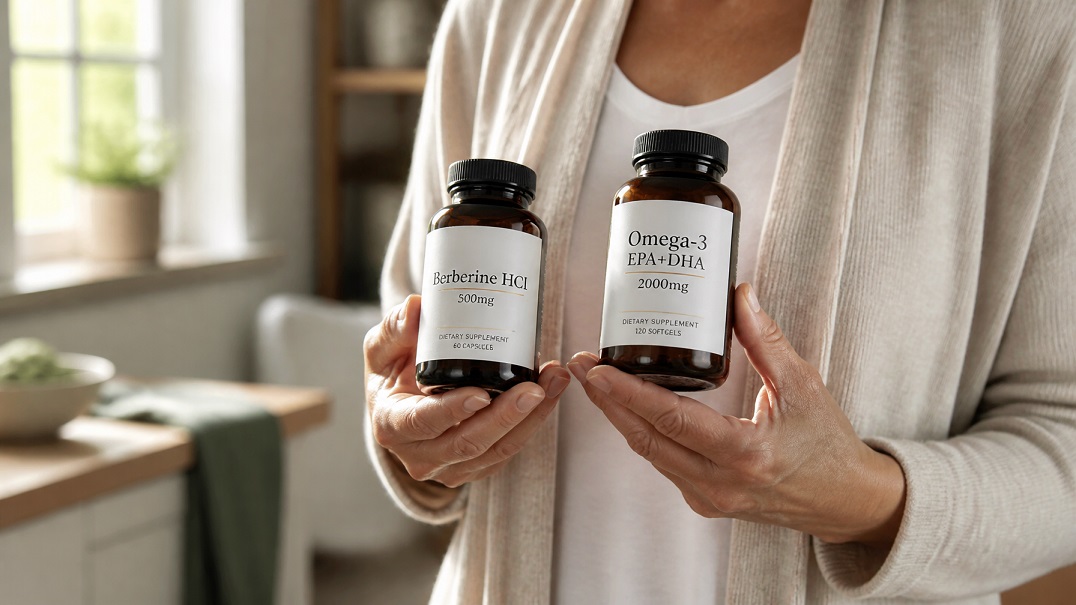
Berberine (500 mg, three times daily with meals)
Berberine is the anchor supplement for natural GLP-1 support, and the evidence justifies that position. It activates AMPK (adenosine monophosphate-activated protein kinase), a cellular energy sensor that improves insulin sensitivity. It also inhibits DPP-4, slowing the breakdown of GLP-1 and allowing it to stay active longer. Human trials show meaningful reductions in fasting blood sugar, post-meal blood sugar, and HbA1c — with the landmark 2008 trial in Metabolism showing results comparable to metformin in people with type 2 diabetes.
The standard dose is 500 mg three times daily, taken just before meals. Because berberine has less than 5% oral bioavailability, timing with meals is important — the food helps slow gastric transit and gives the compound more contact time in the gut. For full dosing guidance, see Berberine Dosage Guide: How Much Do You Actually Need?
Soluble Fiber (10–15 g daily, ideally psyllium husk)
Soluble fiber — particularly psyllium husk — is arguably the most direct natural GLP-1 trigger available without a prescription. Fiber fermented by gut bacteria produces short-chain fatty acids (SCFAs) like butyrate and propionate, which directly stimulate L-cells to release GLP-1. Psyllium also slows gastric emptying, blunts post-meal glucose spikes, and feeds the microbiome populations that sustain GLP-1 production over time.
The dose used in most trials is 10 to 15 grams per day in divided doses, taken with water before or during meals. This is the one supplement in the stack where food sources — oats, legumes, vegetables — genuinely contribute alongside supplemental fiber, so your diet matters here as much as the capsule or powder. See Psyllium Husk and GLP-1: The Fiber Connection for the full breakdown.
Tier 2: High-Value Add-Ons
These supplements have solid evidence and meaningful mechanisms, but they work best layered on top of a Tier 1 foundation rather than as stand-alone solutions. Adding one or two from this tier is a reasonable next step once the foundation is established.
Probiotics (multi-strain, CFU count 10–50 billion)
The gut microbiome is increasingly recognized as a central driver of GLP-1 production. Strains from the Lactobacillus and Bifidobacterium families have the strongest evidence for supporting GLP-1 secretion, partly by producing SCFAs that stimulate L-cells and partly by improving gut barrier integrity. Human trials using specific strains — particularly L. reuteri, L. rhamnosus, and B. longum — have shown improvements in GLP-1, insulin sensitivity, and body composition.
Probiotics pair naturally with fiber because fiber acts as a prebiotic — food for the beneficial bacteria you’re trying to cultivate. Taking a probiotic without adequate fiber is like planting seeds without watering them. For strain-specific guidance, see Probiotics and GLP-1: Which Strains Matter Most?
Green Tea Extract / EGCG (200–400 mg EGCG daily)
EGCG (epigallocatechin gallate), the primary active compound in green tea extract, inhibits DPP-4 — the same enzyme berberine targets — which means it slows GLP-1 breakdown and extends its active window. It also has independent effects on fat oxidation and insulin sensitivity. Human trials have shown reductions in fasting blood glucose and body weight with EGCG supplementation, though the effects are modest.
EGCG works well alongside berberine because they hit the same DPP-4 pathway through slightly different mechanisms, potentially producing an additive effect. The target dose is 200 to 400 mg of EGCG per day, not total green tea extract — read the label carefully since the extract percentage varies widely between products. Full details at Green Tea Extract (EGCG) and GLP-1: What the Science Says.
Omega-3 Fatty Acids (1,000–2,000 mg EPA + DHA daily)
Omega-3s stimulate GLP-1 release directly through the GPR120 receptor on L-cells, reduce the chronic inflammation that blunts GLP-1 signaling, and support a healthier gut microbiome composition. They also bring well-established cardiovascular benefits — triglyceride reduction, blood pressure support, reduced inflammatory markers — that make them valuable even independent of their GLP-1 effects.
For most people, 1,000 to 2,000 mg of combined EPA and DHA daily from a high-quality, third-party-tested fish oil is the practical target. This is one of the most versatile supplements in the stack because its benefits extend well beyond GLP-1. See Omega-3 Fatty Acids and GLP-1: The Fish Oil Connection for full quality and dosing guidance.
Tier 3: Situational Supplements
These supplements have real evidence in specific populations or for specific mechanisms, but they’re not universally necessary. Whether they belong in your stack depends on your individual situation.
Magnesium (300–400 mg daily, glycinate or malate form)
An estimated 45 to 68% of Americans fall short of the RDA for magnesium. Deficiency impairs insulin signaling, increases inflammation, and disrupts glucose metabolism — all of which suppress GLP-1 effectiveness indirectly. For people who are deficient, correcting magnesium levels can meaningfully improve metabolic function. For people who are replete, the marginal benefit is smaller. Magnesium glycinate or malate absorbs well and causes fewer digestive side effects than magnesium oxide. See Magnesium and GLP-1: The Overlooked Mineral Connection.
Curcumin with Piperine (500–1,000 mg curcumin, with black pepper extract)
Curcumin — the active compound in turmeric — has anti-inflammatory and insulin-sensitizing effects that may support GLP-1 function indirectly. The catch is bioavailability: standard curcumin absorbs poorly on its own. Piperine (from black pepper) increases absorption by roughly 2,000%, making it a non-negotiable addition. Curcumin is most relevant for people with significant inflammation, metabolic syndrome, or joint issues alongside their metabolic concerns. See Curcumin and GLP-1: Can Turmeric Move the Needle?
Inositol (2–4 g myo-inositol daily)
Inositol’s primary value is in people with insulin resistance, PCOS, or prediabetes — it improves insulin signal transduction at the cellular level. Its direct effect on GLP-1 secretion is not well established in humans, but it addresses the downstream response to GLP-1, making the whole system function more efficiently. Women with PCOS may find the 40:1 myo-inositol to D-chiro-inositol combination particularly useful. See Inositol and GLP-1: What the Research Shows.
Chromium Picolinate (200–400 mcg daily)
Useful for people who eat a diet heavy in processed foods or who have signs of insulin resistance. Chromium supports insulin receptor sensitivity through the chromodulin pathway. Its direct GLP-1 effects are not established in humans, but it contributes to the metabolic environment that determines how effectively GLP-1 works. Not essential for everyone, but a low-cost, low-risk addition for the right person. See Chromium and Blood Sugar: Does It Support GLP-1?
How to Build Your Stack Practically
Don’t try to start everything at once. Introducing multiple new supplements simultaneously makes it impossible to know what’s working, what’s causing side effects, or what can be dropped if your budget tightens.
A sensible sequence: start with berberine and psyllium in week one. Add a probiotic in week three once your gut has adjusted to the fiber increase. Add green tea extract or omega-3s in week five. Evaluate after 8 to 12 weeks before adding anything from Tier 3.
Watch for interactions. Berberine, chromium, cinnamon, and inositol all have blood-sugar-lowering properties. Stacking several of them while also taking prescription diabetes medication could push glucose lower than intended. If you take any glucose-lowering drug, discuss your supplement plan with your doctor before starting.
A Simple Sample Stack for Most People
- Berberine: 500 mg three times daily with meals
- Psyllium husk: 5 g twice daily before meals, with a full glass of water
- Probiotic: 10–30 billion CFU, multi-strain (Lactobacillus + Bifidobacterium), taken with breakfast
- Fish oil: 1,000–2,000 mg EPA + DHA with dinner
- Magnesium glycinate: 300–400 mg before bed
This covers direct GLP-1 stimulation (fiber, berberine), DPP-4 inhibition (berberine), gut microbiome support (probiotic, fiber), GPR120 activation (fish oil), inflammation reduction (fish oil), and insulin signaling support (magnesium, berberine). Five supplements, multiple mechanisms, no redundancy.
Practical Takeaway: Stack Smart, Not Deep
More supplements is not the same as better results. The goal is to cover the key mechanisms — L-cell stimulation, DPP-4 inhibition, microbiome support, insulin sensitivity, inflammation — without stacking duplicates or chasing marginal additions before the foundation is solid.
Berberine and soluble fiber are the core. Everything else builds on that base. Add thoughtfully, give each addition at least four to six weeks before assessing its contribution, and prioritize quality over quantity in every product you choose.
For guidance on what to avoid and what’s been overstated in the market, see Natural GLP-1 Supplements: What Works, What Doesn’t, and What’s Overhyped.