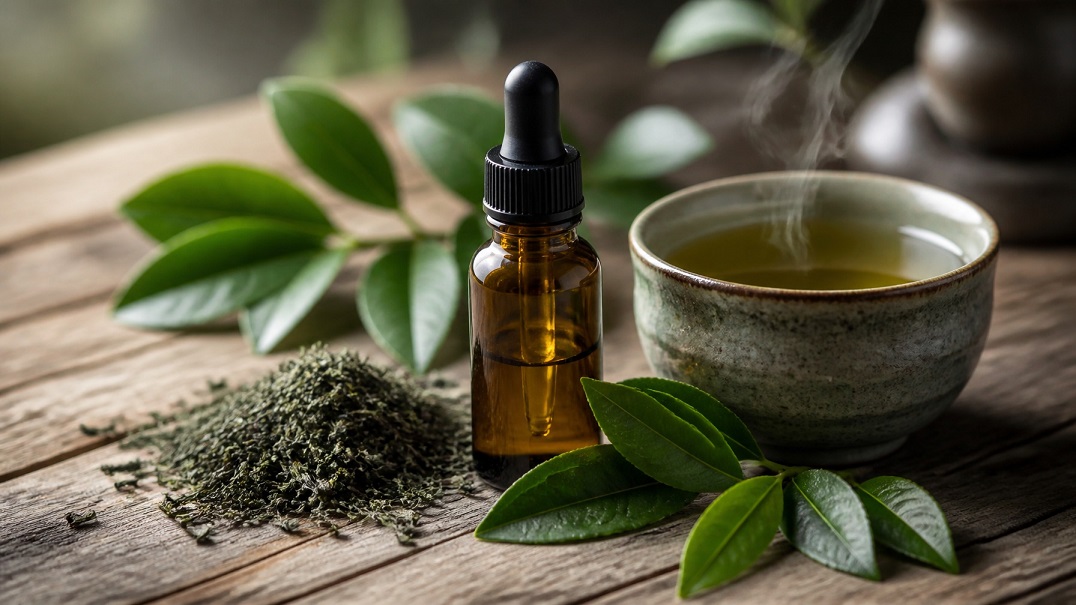
Green tea has been consumed for thousands of years, and its health benefits have been studied extensively enough that separating genuine findings from overstated claims requires some care. In the GLP-1 context specifically, green tea extract — and the compound EGCG it contains — has attracted legitimate research interest for two distinct reasons: its potential to slow the breakdown of natural GLP-1, and its broader metabolic effects on insulin sensitivity, blood sugar, and body weight. The evidence is real but more modest than enthusiastic supplement marketing often suggests. This article covers what EGCG actually does, what the clinical research shows, and how green tea extract fits into a broader natural GLP-1 support strategy.
What EGCG Is and Why It Matters for GLP-1
Green tea extract is a concentrated form of the bioactive compounds found in green tea leaves — primarily a family of antioxidants called catechins. The most abundant and most studied catechin in green tea is epigallocatechin gallate, universally abbreviated as EGCG. It accounts for roughly 50 to 80% of the total catechin content in green tea extract and is responsible for most of the metabolic effects attributed to green tea in research.
EGCG is not a single-trick compound. It has documented antioxidant, anti-inflammatory, and metabolic effects that operate through several mechanisms simultaneously. In the GLP-1 context, two mechanisms are most relevant: its activity as a mild inhibitor of the DPP-4 enzyme, and its effects on insulin sensitivity and glucose metabolism more broadly.
The DPP-4 Connection
As covered in the GLP-1 Glossary, DPP-4 (dipeptidyl peptidase-4) is the enzyme that breaks down natural GLP-1 within one to two minutes of release. Pharmaceutical DPP-4 inhibitors — a drug class called gliptins, which includes sitagliptin (Januvia) and saxagliptin — work by blocking this enzyme to extend the window of GLP-1 activity. A number of in vitro (cell culture) and animal studies have found that EGCG inhibits DPP-4 activity, suggesting it may work through a similar but considerably weaker mechanism.
The practical implication, if this DPP-4 inhibition translates meaningfully to humans, is that EGCG could extend the effective half-life of naturally produced GLP-1 — making each post-meal GLP-1 pulse last longer before being cleared. This would be a genuine and useful contribution to a natural GLP-1 support strategy, particularly when combined with supplements like berberine that stimulate GLP-1 release. The evidence chain here runs from cell and animal studies to human mechanistic plausibility — direct human trial confirmation of EGCG’s DPP-4 inhibition effect on circulating GLP-1 levels is more limited than the mechanistic evidence would suggest.
What the Human Research Actually Shows
Moving from mechanism to outcomes, the human clinical evidence for green tea extract and EGCG spans several metabolic endpoints — weight, blood sugar, insulin sensitivity, and fat oxidation — with varying degrees of consistency and effect size.
Weight and Body Composition
The most extensively studied application of green tea extract in humans is weight management. A 2012 Cochrane review — one of the most rigorous evidence review processes in medicine — examined randomized controlled trials of green tea preparations for weight loss and found a small but statistically significant reduction in body weight compared to control conditions. The average weight loss across studies was modest: roughly 0.2 to 3.5 kilograms over the trial periods, with considerable variation between studies.
A 2009 meta-analysis in the International Journal of Obesity found that green tea catechins combined with caffeine produced more consistent weight and fat loss than catechins alone, suggesting caffeine amplifies EGCG’s metabolic effects — a finding consistent with the way most commercial green tea extract supplements formulate their products. The weight effects appear most pronounced in people who are not already heavy caffeine consumers, since habitual caffeine use blunts some of the synergistic thermogenic effect.
Blood Sugar and Insulin Sensitivity
Multiple trials have examined green tea extract’s effects on blood sugar and insulin sensitivity, with generally positive but modest results. A 2013 meta-analysis in the American Journal of Clinical Nutrition found that green tea consumption was associated with significant reductions in fasting blood sugar and HbA1c in people with and without type 2 diabetes. The reductions were real but smaller in magnitude than those seen with berberine or prescription interventions.
The proposed mechanisms include EGCG’s inhibition of glucose transport enzymes in the gut — potentially slowing glucose absorption after meals — and its effects on insulin receptor signaling that may improve cellular glucose uptake. These mechanisms are plausible and consistent with the observed blood sugar effects, though the human evidence base is not as large or as methodologically consistent as for berberine.
Fat Oxidation and Energy Expenditure
One of green tea extract’s more reliably demonstrated effects is an increase in fat oxidation — the rate at which the body burns fat for energy. A frequently cited study published in the American Journal of Clinical Nutrition found that green tea extract increased 24-hour energy expenditure by roughly 4% and fat oxidation by approximately 17% compared to placebo. These are acute effects measured over short periods, and their translation to meaningful long-term fat loss depends heavily on how consistently the supplement is used and whether dietary intake is appropriately managed alongside it.
How Much EGCG Do You Need?
The doses used in human clinical trials vary considerably, which makes precise dosing recommendations difficult. Most studies showing meaningful metabolic effects have used green tea extract providing between 200 and 800 milligrams of EGCG per day. The lower end of this range — around 200 to 400 milligrams of EGCG daily — appears sufficient for most people’s needs and carries a more favorable safety profile than higher doses.
A standard cup of brewed green tea contains roughly 50 to 100 milligrams of EGCG, meaning three to six cups per day would be needed to reach the lower end of the research dose range through tea alone. Green tea extract supplements allow this dose to be achieved more reliably and conveniently, though the bioavailability of EGCG from supplements varies by formulation.
Standardized Extract vs. Plain Green Tea
For metabolic health purposes, standardized green tea extract — products specifying their EGCG content on the label — is preferable to non-standardized products or simply drinking more tea. The EGCG content of brewed green tea varies significantly depending on brewing time, water temperature, leaf grade, and tea type. A standardized extract with a specified EGCG content allows for more consistent and reliable dosing. When evaluating green tea extract products, the supplement facts panel should list the EGCG content specifically, not just the total green tea extract amount.
Safety Considerations for Green Tea Extract
Green tea is consumed safely by billions of people daily as a beverage. Green tea extract supplements, however, concentrate the bioactive compounds to levels that can exceed what is achievable through tea drinking — and at high doses, this concentration creates safety considerations that don’t apply to ordinary tea consumption.
Liver Toxicity at High Doses
The most significant safety concern with green tea extract is hepatotoxicity — liver damage — at high doses. Case reports and regulatory agency reviews have identified rare cases of liver injury associated with concentrated green tea extract supplements, particularly at doses above 800 milligrams of EGCG per day and in people with underlying liver vulnerability. This risk is rare at moderate doses and appears primarily associated with very high-dose supplements or products taken on an empty stomach.
The practical guidance from regulatory agencies and researchers is to use green tea extract at moderate doses — 200 to 400 milligrams of EGCG per day — take it with food rather than on an empty stomach, and avoid it if you have pre-existing liver conditions. At these doses, the liver risk appears negligible for most healthy adults.
Caffeine Content
Most green tea extract supplements contain caffeine unless specifically labeled as decaffeinated. Caffeine amplifies some of EGCG’s metabolic effects but also adds stimulant effects — increased heart rate, potential sleep disruption, and anxiety in caffeine-sensitive individuals — that need to be factored into your overall caffeine intake. People who are caffeine-sensitive or who already consume substantial caffeine from other sources should opt for decaffeinated green tea extract or factor the supplement’s caffeine content into their daily total.
Where Green Tea Extract Fits in a Natural GLP-1 Strategy
Green tea extract is not the most impactful supplement in a natural GLP-1 support strategy — that distinction belongs to berberine, which has a stronger and larger human evidence base for metabolic effects. But EGCG’s potential DPP-4 inhibiting activity gives it a complementary role that berberine doesn’t fill: rather than stimulating more GLP-1 production, it may help extend the life of the GLP-1 that berberine and dietary fiber stimulate. The combination of a GLP-1 stimulator (berberine, dietary fiber) and a potential GLP-1 preserver (EGCG) is mechanistically coherent, even if direct human evidence for this specific combination is limited.
Green tea extract also contributes independently useful effects on fat oxidation, insulin sensitivity, and modest weight support that add value beyond the GLP-1 pathway specifically. At reasonable doses and with the liver safety precautions observed, it is a low-risk, moderate-benefit addition to a natural GLP-1 supplement stack.
For guidance on choosing a high-quality green tea extract product and what to look for on the label, see How to Choose a High-Quality Green Tea Extract Supplement. For how green tea extract fits alongside berberine and other natural GLP-1 boosters in a coherent supplement strategy, see The Best Supplement Stack for Natural GLP-1 Support.