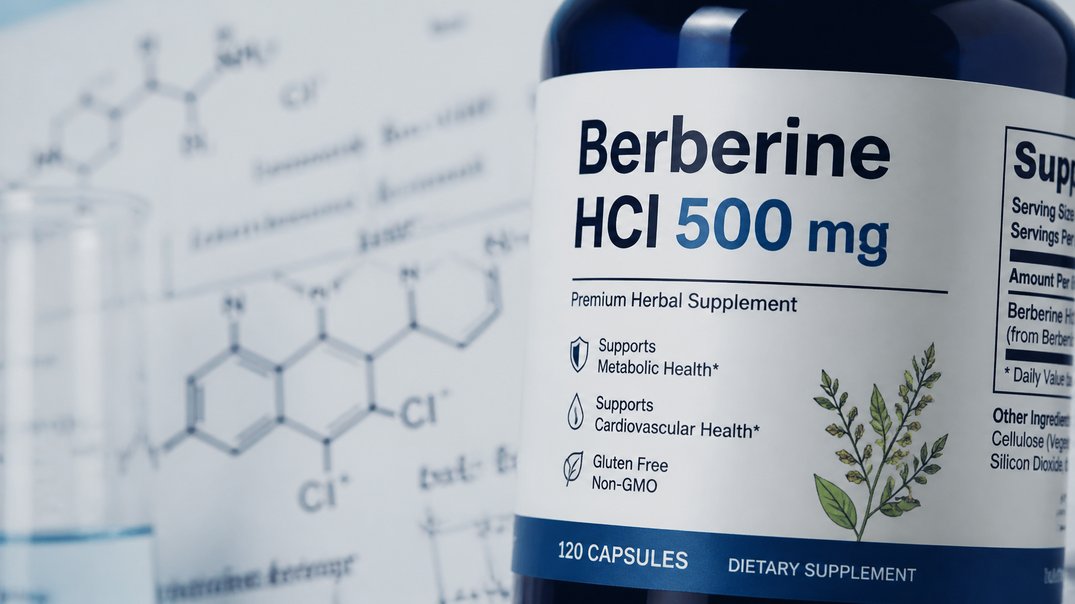
If you’ve shopped for berberine supplements, you’ve probably noticed that some labels say “berberine” and others say “berberine HCl.” Some products list both. A few use entirely different terminology — “berberine hydrochloride,” “berberine sulfate,” or just “berberine extract.” It’s reasonable to wonder whether these are meaningfully different things or just labeling variations on the same ingredient. The answer matters: the form of berberine determines its chemistry, stability, and how it relates to the clinical trial evidence most people are relying on when they choose to take it.
What “Berberine” Actually Is
Berberine is a naturally occurring plant alkaloid — a nitrogen-containing compound — found in several medicinal plants including Berberis aristata (Indian barberry), Coptis chinensis (goldenseal’s Chinese relative), Hydrastis canadensis (American goldenseal), and Phellodendron amurense (Amur cork tree). The compound responsible for the metabolic effects described throughout this site is the berberine molecule itself — specifically its ability to activate AMPK, stimulate GLP-1 secretion, and improve insulin sensitivity.
Pure berberine in its free base form is a yellow crystalline compound that is poorly soluble in water and relatively unstable. In nature and in commercial extraction, berberine almost always exists as a salt — chemically combined with an acid to form a more stable, more soluble compound. The salt form changes some physical properties (solubility, stability, hygroscopicity) without changing the core berberine molecule or its biological activity.
So when a label says “berberine HCl,” it means berberine combined with hydrochloric acid to form berberine hydrochloride — a salt. The berberine molecule inside is the same; the HCl is the counterion that makes it a stable, manufacturable salt. This is the same principle as vitamin C existing as ascorbic acid versus sodium ascorbate — different salt forms, same core vitamin molecule.
Berberine HCl: Why It’s the Standard
Berberine hydrochloride (HCl) is by far the most common commercial form of berberine and the form used in virtually all human clinical trials. When the landmark 2008 Metabolism study showed berberine matching metformin for blood sugar control, it used berberine HCl at 1,500 mg/day. When PCOS trials compared berberine to metformin in women, they used berberine HCl. When meta-analyses summarized berberine’s effects on LDL, triglycerides, and HbA1c, the underlying trials overwhelmingly used berberine HCl.
This matters for a practical reason: when you read clinical evidence for berberine and then choose a supplement, you want to be taking the form the evidence applies to. If a product uses a different berberine salt and cites berberine HCl trial results as support, it’s referencing evidence from a chemically related but distinct compound.
Berberine HCl is highly stable, has good manufacturing characteristics (flows well through capsule-filling equipment, doesn’t absorb moisture excessively), and is available from multiple established suppliers in standardized purity grades. These practical manufacturing advantages are part of why it became the research standard — it was consistent enough to study reliably.
What the HCl Percentage Tells You
Berberine HCl has a molecular weight slightly higher than berberine free base because the HCl adds mass. Pure berberine HCl is approximately 85–90% berberine by molecular weight — the rest is the hydrochloride counterion. This means a 500 mg dose of berberine HCl delivers approximately 425–450 mg of actual berberine alkaloid.
This is a minor technical point for most purposes — clinical trials measured and dosed berberine HCl as a compound, so the evidence supports 500 mg of berberine HCl three times daily, not 500 mg of pure berberine alkaloid. Products labeled in berberine HCl weight are directly comparable to the research. The distinction only becomes relevant if a product starts comparing its “pure berberine” content to another product’s “berberine HCl” content at the same milligram level — technically 500 mg of pure berberine alkaloid contains slightly more active compound than 500 mg of berberine HCl, but the practical difference is small.
Other Berberine Salt Forms
Several other berberine salts appear in supplements, each with slightly different properties but the same core berberine molecule.
Berberine sulfate is less soluble than berberine HCl and less commonly used in commercial supplements. Some research suggests it may have slightly different absorption characteristics, but the clinical trial database for berberine sulfate is far smaller than for berberine HCl. Products using berberine sulfate while citing berberine HCl research are in somewhat shakier evidentiary territory.
Berberine tannate combines berberine with tannic acid. It’s occasionally used in formulations where the tannate complex is claimed to improve stability or reduce GI side effects, but again the human trial evidence is limited compared to HCl.
Berberine phosphate and other salt forms appear in some products, often marketed as enhanced or superior to standard HCl. The evidence base for these forms in humans is thin. The burden of proof for claiming equivalent or superior efficacy to berberine HCl requires human trial data that these forms largely lack.
For practical purposes: if a supplement uses a berberine salt form other than HCl, the product should ideally provide specific evidence for that form’s efficacy in humans at the doses used — not rely on berberine HCl clinical trials as proxy evidence.
Berberine Extract vs. Berberine HCl: Standardization Matters
Some products list “berberine extract” rather than “berberine HCl.” This requires closer examination because “extract” is less specific than a named salt form.
A berberine extract is a concentrated preparation from a berberine-containing plant, but its actual berberine content depends entirely on the standardization of the extract. An extract standardized to 97% berberine HCl is essentially pure berberine HCl by another name. An extract standardized to 20% berberine alkaloids from a whole-plant preparation contains a range of alkaloids — some berberine, plus related compounds like coptisine, palmatine, and jatrorrhizine — at a fraction of the concentration of a pure berberine HCl product.
When evaluating a “berberine extract” product, look for the standardization percentage disclosed in the Supplement Facts panel. “Berberine extract (standardized to 97% berberine HCl)” is effectively identical to pure berberine HCl at the stated dose. “Berberine root extract 500 mg” without a standardization disclosure tells you almost nothing about how much actual berberine you’re getting — 500 mg of a 5% berberine extract contains 25 mg of berberine, while 500 mg of a 95% extract contains 475 mg.
The “Berberine Capsules” Question
The phrase “berberine capsules” simply describes the delivery format — capsules — rather than the chemical form of berberine inside. A capsule containing berberine HCl is a berberine capsule. A capsule containing berberine sulfate is also a berberine capsule. The word “capsule” on a label or product name tells you the physical format, not the chemistry.
What matters is what’s inside the capsule, which is disclosed in the Supplement Facts panel. “Berberine HCl 500 mg” inside a vegetable capsule is the information you need — not whether the product name says “Berberine Capsules” or “Berberine HCl Capsules” or just “Berberine.” Some manufacturers use “Berberine HCl” in the product name to signal quality transparency; others use plain “Berberine” for clean branding without disclosing less. The name alone doesn’t tell you what’s inside. The Supplement Facts panel does.
Berberine HCl vs. Dihydroberberine: The Bioavailability Question
The most meaningful distinction in the berberine supplement market isn’t between berberine HCl and other salts — it’s between berberine HCl and dihydroberberine (DHB). Dihydroberberine is a reduced form of berberine — chemically related but distinct, produced by reducing the berberine molecule. It’s not a salt form of berberine but a different compound entirely.
Dihydroberberine claims to have significantly higher oral bioavailability than berberine HCl — some studies suggest five to ten times higher systemic absorption. The proposed mechanism is that dihydroberberine is absorbed more efficiently in the gut and then converted back to berberine and other active forms in the intestinal wall. If this is accurate, a lower dose of dihydroberberine could theoretically achieve equivalent blood levels to a higher dose of berberine HCl.
Products containing dihydroberberine typically use doses of 100–300 mg per serving rather than the 500 mg per serving of berberine HCl — the lower dose reflecting the claimed higher bioavailability. The critical question is whether the human clinical outcome evidence — blood sugar reduction, lipid improvements, insulin sensitivity gains — is equivalent at these lower doses of dihydroberberine.
The honest answer is: we don’t fully know yet. The pharmacokinetic evidence for dihydroberberine’s superior absorption is reasonably supported. But the PCOS trials, the metformin comparison studies, the HbA1c reduction data — all of this evidence was generated using berberine HCl at 1,500 mg/day, not dihydroberberine at 300–600 mg/day. Whether equivalent clinical outcomes follow from equivalent blood levels of the converted compound is a reasonable assumption that hasn’t been directly tested in large human outcome trials.
For people who want to take berberine and are confident in the evidence base, berberine HCl at 1,500 mg/day is the form with proven human outcomes. For people interested in potentially equivalent effects at lower doses with possibly better absorption, dihydroberberine is a reasonable consideration with the understanding that the outcome evidence trail is shorter. Our article on the best forms of berberine covers dihydroberberine and other emerging forms in more detail.
What to Look For on the Label
Armed with this context, evaluating a berberine supplement label becomes straightforward. In the Supplement Facts panel, find the berberine entry and check for three things:
First, the form: Look for “berberine HCl,” “berberine hydrochloride,” or “berberine (as berberine HCl).” These all indicate the standard clinical trial form. “Berberine extract” requires checking the standardization percentage. Dihydroberberine will be listed as such — it’s a different compound, not just a naming variation.
Second, the amount: The amount per serving should be 500 mg for berberine HCl at a three-times-daily protocol (reaching the 1,500 mg/day clinical target). For dihydroberberine, the dose is typically 100–300 mg per serving, which reflects the different dosing rationale. Comparing a 500 mg berberine HCl product to a 200 mg dihydroberberine product isn’t comparing the same dose — it’s comparing different forms at their respective studied doses.
Third, the standardization (for extracts): If the label says “berberine extract,” find the standardization percentage disclosed in parentheses or nearby. A product that doesn’t disclose standardization for an extract is not giving you enough information to evaluate what you’re buying.
The capsule format itself — vegetable vs. gelatin, size, coating — is secondary to getting the form and dose right. A product that specifies berberine HCl at 500 mg per capsule with a three-times-daily recommendation, manufactured in a GMP facility and third-party verified, is the product profile that the clinical evidence most directly supports. Our article on what to look for when buying a berberine supplement covers the full buying checklist beyond just the form question.