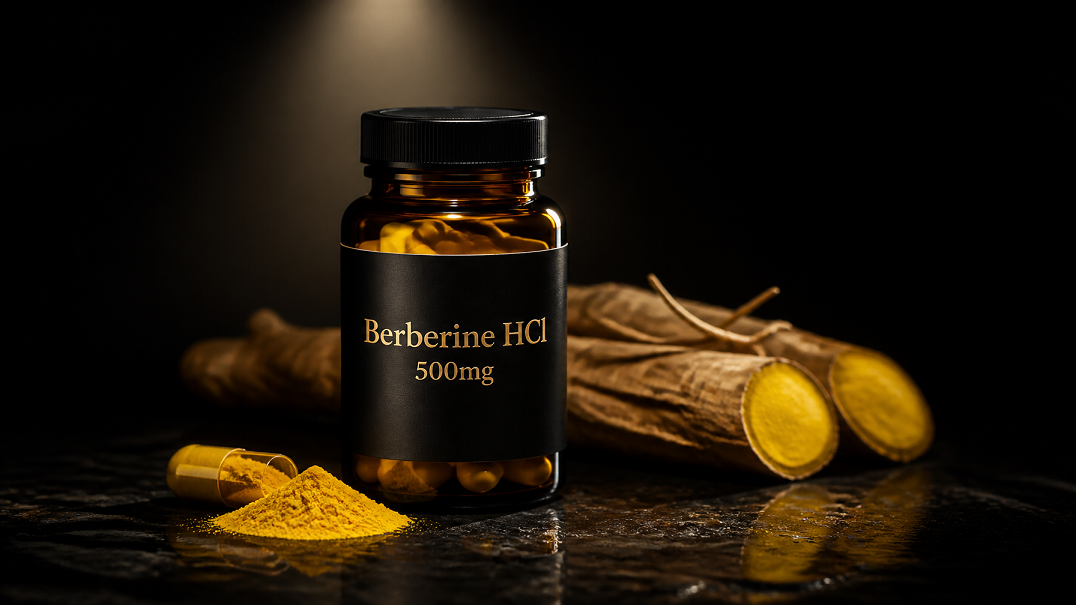
The berberine supplement market has evolved considerably in recent years. What was once a single-option category — berberine HCl in a capsule — now includes dihydroberberine, phytosome complexes, liposomal formulations, and various enhanced bioavailability systems. The marketing claims for newer forms can be compelling: “five times the absorption,” “superior bioavailability,” “more effective at lower doses.” Some of these claims have real science behind them. Others are extrapolating from limited data to commercial conclusions. This article is a direct comparison of the main berberine forms, what the evidence actually shows for each, and how to decide which makes sense for your situation.
Why Berberine Form Matters: The Bioavailability Problem
To understand why different berberine forms exist, you need to start with berberine’s fundamental bioavailability challenge. Standard berberine HCl has notoriously poor oral bioavailability — less than 5% of an oral dose reaches systemic circulation as measured by plasma levels. The molecule is poorly absorbed across the gut wall, rapidly metabolized by gut bacteria, and subject to significant first-pass metabolism in the liver.
This sounds like a fatal flaw, but the clinical evidence tells a more nuanced story. Berberine at 1,500 mg/day produces significant reductions in blood sugar, HbA1c, triglycerides, and LDL cholesterol in human trials — effects that are clearly happening despite low measured plasma concentrations. The explanation is that some of berberine’s most important actions occur locally in the gut rather than systemically: stimulating GLP-1 secretion from L-cells, altering gut microbiome composition, and supporting gut barrier integrity don’t require high plasma levels. AMPK activation in the liver and peripheral tissues does require systemic absorption, but berberine apparently reaches these tissues at sufficient concentrations despite low plasma levels — possibly through portal circulation concentrations that exceed systemic plasma levels.
The question newer berberine forms are trying to answer is: can improved systemic bioavailability produce better metabolic outcomes at lower doses, or with stronger effects at equivalent doses? The answer differs by form.
Berberine HCl: The Clinical Gold Standard
Berberine hydrochloride (HCl) is the salt form of berberine used in virtually all human clinical trials published to date. The evidence base for berberine HCl is substantial by supplement standards: multiple randomized controlled trials comparing it to metformin for blood sugar and PCOS outcomes, a landmark 2008 Metabolism study (116 people, 1,500 mg/day, fasting blood sugar down ~20%, post-meal blood sugar down ~26%, HbA1c reduced ~2 points), multiple meta-analyses confirming lipid improvements, and direct PCOS comparison trials showing hormonal and metabolic benefits comparable to pharmaceutical comparators.
The standard dose of 500 mg three times daily with meals (1,500 mg/day total) is what produced these outcomes. This is the dose that should appear on the label of any berberine HCl product claiming to be evidence-supported. Products dosed below this are extrapolating below the studied range.
Berberine HCl is highly stable, widely available from multiple established suppliers, and relatively inexpensive to manufacture. Its main limitation is the bioavailability issue — which, as noted above, doesn’t prevent clinical efficacy but does mean a large portion of each dose exits the body without systemic absorption. For people who tolerate berberine HCl well and are willing to take three doses daily, it remains the form with the most direct and extensive clinical evidence.
Best for: Anyone wanting the most evidence-backed form with clear dosing guidance. Standard of comparison against which all other forms should be evaluated.
Dose: 500 mg three times daily with meals.
Evidence level: High — multiple large human RCTs and meta-analyses.
Dihydroberberine: The High-Bioavailability Alternative
Dihydroberberine (DHB) is a reduced form of berberine — chemically distinct from berberine HCl, not just a salt variation. It’s produced by reducing the C-N double bond in berberine’s molecular structure, which changes its physical properties significantly: it’s more lipid-soluble, more readily absorbed across the gut wall, and less susceptible to gut bacterial metabolism than standard berberine.
The pharmacokinetic case for dihydroberberine is genuine. A 2021 study found that dihydroberberine produced approximately five times higher plasma berberine levels than an equivalent dose of berberine HCl — the body absorbs it more efficiently and converts it back to berberine and other active metabolites in the intestinal wall. In theory, 100–200 mg of dihydroberberine might produce systemic berberine exposure comparable to 500–1,000 mg of berberine HCl.
Dihydroberberine products typically use doses of 100–300 mg per serving, reflecting this claimed bioavailability advantage. Some products market this as “more convenient” (fewer capsules) or “gentler on the digestive system” (less berberine reaching the colon, potentially reducing GI side effects).
The critical limitation of dihydroberberine is the evidence gap between pharmacokinetics and clinical outcomes. Higher plasma berberine levels after dihydroberberine administration is a pharmacokinetic finding — it tells us how the compound is absorbed, not whether equivalent plasma levels from dihydroberberine produce the same metabolic outcomes as the doses of berberine HCl used in clinical trials. The PCOS trials, the metformin comparison studies, the HbA1c reduction data — all were generated using berberine HCl at 1,500 mg/day, not dihydroberberine at 300–600 mg/day.
This evidence gap also has a specific implication for gut-mediated effects. Remember that berberine HCl’s actions on GLP-1 secretion, gut microbiome composition, and gut barrier integrity happen locally in the gut. Dihydroberberine’s superior systemic absorption means less remains in the gut to exert these local effects. If a meaningful portion of berberine HCl’s metabolic benefit comes from gut-local actions, a form that gets absorbed before reaching the colon might actually produce worse outcomes for those specific mechanisms — even while producing better systemic plasma levels.
Best for: People who have tried berberine HCl and experienced significant GI side effects, or those who want potentially equivalent systemic effects at lower capsule burden, understanding they’re operating outside the direct clinical trial evidence.
Dose: 100–300 mg per serving, one to three times daily depending on product.
Evidence level: Moderate — strong pharmacokinetic evidence, limited clinical outcome trial data specifically for DHB.
Berberine Phytosomes: Lipid-Complexed Delivery
Phytosome technology binds berberine to phospholipids — the same molecules that form cell membranes — creating a complex that is more lipid-soluble and more readily transported across the gut wall than standard berberine HCl. The technology is established for curcumin (Meriva phytosome) and has been applied to berberine in several products.
A 2019 study comparing berberine phytosome to standard berberine HCl found that the phytosome form produced approximately 10 times higher plasma berberine concentrations at the same dose. This is a larger bioavailability improvement than dihydroberberine claims, at least in this study’s comparison.
However, the same evidence limitation applies as with dihydroberberine: higher plasma levels don’t automatically translate to superior clinical outcomes, particularly for a compound whose efficacy appears to involve gut-local mechanisms. The berberine phytosome clinical outcome literature is smaller than for berberine HCl, and the dose-outcome relationship in human metabolic trials hasn’t been established with the same rigor as the HCl evidence base.
Berberine phytosomes are also more expensive to produce than berberine HCl, which translates to higher product prices. Whether the price premium is justified by meaningfully superior outcomes isn’t established by available evidence.
Best for: People who want potentially higher systemic bioavailability through a technology with established precedent in other supplements (curcumin phytosome). Worth considering if HCl causes GI issues and dihydroberberine isn’t available.
Dose: Varies by product; typically lower than HCl doses but not as extensively studied as DHB dosing.
Evidence level: Limited — pharmacokinetic data promising, clinical outcome data sparse.
Liposomal Berberine
Liposomal delivery encapsulates berberine in lipid vesicles (liposomes) that protect it from gut degradation and improve absorption across intestinal membranes. Liposomal technology is well-established for pharmaceutical drug delivery and has been applied to several supplements including vitamin C and glutathione.
For berberine specifically, the evidence for liposomal delivery improving clinical outcomes is very limited. Most of the claims rest on the general pharmacology of liposomal delivery systems rather than berberine-specific human trials. There are no large-scale liposomal berberine clinical trials comparable to the berberine HCl evidence base.
Liposomal berberine products tend to be the most expensive formulations in the market, often significantly so. The price premium substantially outpaces the supporting evidence. For most users, the cost-benefit calculation doesn’t favor liposomal berberine over well-verified berberine HCl or dihydroberberine.
Best for: Primarily relevant for people with documented gut absorption problems or specific reasons to pursue maximum systemic bioavailability; otherwise hard to justify the cost premium given the evidence gap.
Evidence level: Low for berberine specifically — relies on liposomal technology evidence from other compounds.
Berberine with Piperine: The Enhanced HCl Approach
Rather than using a chemically modified berberine form, some products combine standard berberine HCl with piperine — the active compound in black pepper that famously increases curcumin bioavailability by approximately 2,000%. Piperine inhibits the metabolic enzymes and efflux transporters that otherwise rapidly clear berberine from gut cells, allowing more berberine to remain available for absorption.
The evidence for piperine enhancing berberine bioavailability is positive but shows smaller effect sizes than the dramatic curcumin improvement — roughly 30–50% increases in berberine plasma levels, not multiples of five or ten. This is a modest enhancement that may meaningfully improve systemic bioavailability without the theoretical trade-off of reducing gut-local berberine actions.
The piperine-berberine combination keeps the active compound as standard berberine HCl — maintaining full relevance to the clinical trial evidence base — while modestly improving absorption. For people who want to stay close to the evidence while getting some bioavailability enhancement, this combination is worth considering. It’s also significantly cheaper than dihydroberberine or phytosome products.
One practical caveat: piperine inhibits CYP3A4 and other drug-metabolizing enzymes — the same enzymes berberine itself inhibits. The combination may produce additive drug interaction effects, making medication review with a pharmacist more important before starting a berberine-piperine product than for berberine HCl alone.
Best for: People who want modest bioavailability enhancement while staying on evidence-supported berberine HCl. Good cost-to-benefit profile for bioavailability enhancement.
Dose: Standard berberine HCl dosing (500 mg three times daily); piperine typically at 5–10 mg per serving.
Evidence level: Moderate — established piperine mechanism, modest berberine-specific bioavailability data.
Which Form Should You Choose?
The answer depends on what you’re optimizing for:
If you want maximum evidence alignment: Berberine HCl at 500 mg three times daily with meals. Every major clinical trial outcome you’ve read about was produced by this form at this dose. The evidence applies directly.
If you experience significant GI side effects with berberine HCl: Try dihydroberberine first. The reduced gut berberine burden is the most cited mechanism for better GI tolerability, and the bioavailability advantage means lower capsule doses may produce comparable systemic effects. Accept that you’re moving beyond direct clinical trial evidence.
If you want modest bioavailability enhancement while staying on berberine HCl: A berberine HCl plus piperine combination is the most cost-effective option, though the drug interaction caveat applies more strongly.
If cost is a significant factor: Berberine HCl is by far the least expensive option and has the strongest evidence base. Paying more for dihydroberberine or phytosomes is paying for theoretical advantages that haven’t been confirmed to produce superior outcomes in head-to-head clinical trials.
Whatever form you choose, look for third-party testing, transparent labeling, and GMP manufacturing — quality markers that matter regardless of the form question. Our article on what to look for when buying a berberine supplement covers the full evaluation checklist that applies to any berberine form. And our broader article on berberine and GLP-1: what the research actually shows gives you the clinical evidence context for whichever form you ultimately choose.