If berberine is the most studied supplement for natural GLP-1 support, psyllium husk is arguably the most underappreciated. It doesn’t carry the same “nature’s Ozempic” headlines, it isn’t the subject of viral social media posts, and it costs a fraction of what most metabolic supplements do. What it has is a consistent, well-characterized mechanism for stimulating GLP-1 release, a strong evidence base for improving satiety and blood sugar, and a safety profile that makes almost every other supplement on this site look complicated by comparison. For anyone building a natural GLP-1 support strategy, psyllium deserves a closer look than it typically gets.
What Psyllium Husk Is and Where It Comes From
Psyllium husk is derived from the seeds of Plantago ovata, a plant native to India and now cultivated widely across South Asia. The husk — the outer coating of the seed — is separated from the seed itself and processed into the powder or capsule form most commonly sold as a supplement. India remains the world’s primary producer, supplying the majority of psyllium used globally in both food products and supplements.
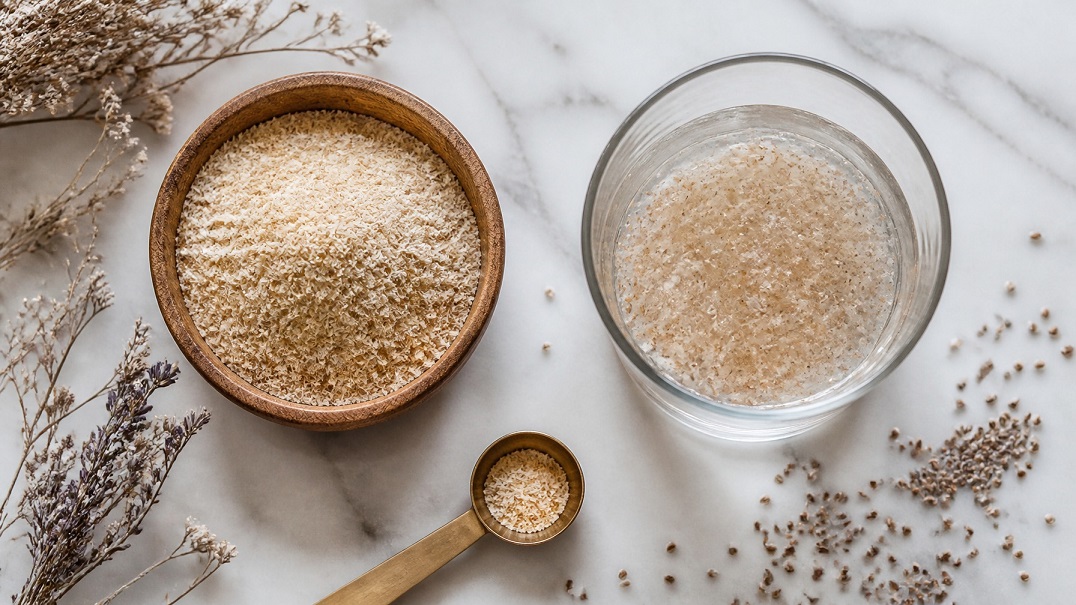
Psyllium is classified as a soluble fiber — specifically a gel-forming soluble fiber. When it contacts water, it absorbs it rapidly and expands into a viscous, gel-like mass. This physical property is central to most of psyllium’s health effects and distinguishes it from insoluble fibers, which pass through the gut relatively unchanged. A single teaspoon of psyllium powder mixed into water visibly thickens the liquid within a minute or two — a tangible demonstration of the gel-forming capacity that drives its GLP-1 and metabolic effects.
Psyllium vs. Other Fiber Sources
Dietary fiber from food — oats, legumes, vegetables, whole grains — provides a mix of soluble and insoluble fiber with a broad range of fermentable substrates for gut bacteria. Psyllium husk provides a concentrated, highly consistent source of soluble fiber in a form that is easy to dose precisely and add to any dietary pattern. It is not a replacement for dietary fiber from whole foods — those foods provide nutrients, phytochemicals, and fiber diversity that psyllium alone doesn’t offer. It is a practical, concentrated supplement option for people whose dietary fiber intake is inadequate or who want targeted fiber support for specific metabolic goals.
How Psyllium Stimulates GLP-1
Psyllium’s GLP-1 effects operate through the same foundational pathway as dietary fiber more broadly — but with some specific features worth understanding.
When psyllium reaches the colon, gut bacteria ferment it — though more slowly and less completely than many other fermentable fibers like inulin or resistant starch. This fermentation produces short-chain fatty acids (SCFAs), particularly butyrate and propionate, which directly stimulate L-cells in the colon to release GLP-1. The fermentation is slower with psyllium than with some other fibers, which is actually part of why it’s well-tolerated — it produces less rapid gas generation than highly fermentable fibers like inulin, which can cause significant bloating in people with sensitive guts.
Beyond fermentation, psyllium’s gel-forming property contributes to GLP-1 stimulation through a second mechanism: by slowing gastric emptying and the transit of food through the small intestine, psyllium extends the time that nutrients are in contact with the L-cell-rich regions of the lower small intestine and colon. This prolonged nutrient contact increases the total GLP-1 stimulation per meal compared to what the same nutrients would produce without psyllium slowing their passage. As explained in The Role of the L-Cell in GLP-1 Production, getting nutrients to the L-cell-dense lower gut is a key lever for GLP-1 output — and psyllium’s gel slows transit in exactly the way that maximizes this contact.
The Glucose-Slowing Effect
Psyllium’s viscous gel also physically traps glucose molecules in the small intestine, slowing their absorption into the bloodstream. This reduces the rate of post-meal glucose entry — producing a flatter blood sugar curve after meals — independently of its GLP-1 effects, though the two mechanisms reinforce each other. The combination of slower glucose absorption and stronger GLP-1-mediated insulin response produces better post-meal blood sugar management than either effect alone.
What the Clinical Research Shows
Psyllium has a substantial research base, though most of it focuses on cholesterol, blood sugar, and satiety rather than GLP-1 levels directly. The indirect evidence for GLP-1 involvement in these effects is strong, even where GLP-1 wasn’t measured as a primary endpoint.
Satiety and Appetite
Multiple studies have found that psyllium supplementation before meals reduces appetite and increases post-meal satiety compared to placebo. A 2016 study published in Appetite found that psyllium taken before meals significantly reduced hunger and increased fullness ratings over a 12-week period, with participants consuming fewer calories at subsequent meals. A 2020 review in Nutrition Reviews confirmed that viscous fiber supplements — of which psyllium is a primary example — consistently reduce appetite and energy intake across a broad range of trials.
These satiety effects are consistent with GLP-1 mediation, though the studies rarely measure GLP-1 directly. The mechanism — gel formation slowing gastric emptying, extended nutrient contact with L-cells, SCFA production stimulating GLP-1 release — is well supported by the mechanistic literature even where the clinical trials focus on downstream outcomes.
Blood Sugar and Insulin Response
Psyllium’s blood sugar effects are among its most consistently documented benefits. A 2018 meta-analysis in the European Journal of Clinical Nutrition found that psyllium supplementation significantly reduced fasting blood sugar, post-meal blood sugar, and HbA1c in people with type 2 diabetes. Reductions in fasting blood sugar averaged approximately 6% across studies, and HbA1c reductions averaged roughly 0.8 percentage points — meaningful improvements for people managing blood sugar.
In people without diabetes, psyllium consistently reduces post-meal blood sugar spikes when taken before or with meals. This is particularly relevant for people experiencing the energy crashes and renewed hunger associated with blood sugar volatility — one of the more common signs of suboptimal GLP-1 function described in Signs Your GLP-1 Levels May Be Low.
Cholesterol: A Bonus Benefit
Psyllium’s effect on LDL cholesterol is one of its most robust and well-established findings — robust enough that the FDA has authorized a health claim for psyllium’s role in reducing the risk of heart disease by lowering cholesterol. Psyllium’s gel binds bile acids in the intestine, preventing their reabsorption and forcing the liver to convert more cholesterol into new bile acids — a process that draws LDL cholesterol from the bloodstream. Studies typically show LDL reductions of 5 to 10% with psyllium supplementation, a meaningful benefit for people with cardiovascular risk concerns alongside their metabolic goals.
How to Use Psyllium Husk Effectively
Psyllium is one of the more straightforward supplements to use correctly, but a few practical details make a meaningful difference in both effectiveness and tolerability.
Timing: Before Meals Is Key
For GLP-1 support and appetite management, taking psyllium 15 to 30 minutes before a meal — mixed into a large glass of water and consumed promptly — is the most effective approach. This allows the gel to form in the stomach before food arrives, priming the gastric emptying slowdown and setting up the conditions for extended nutrient contact with L-cells. Taking psyllium with a meal rather than before it still provides benefit but blunts the pre-meal appetite-reducing effect that comes from having the gel already present when eating begins.
Dose: Start Low and Build Gradually
Psyllium is well-tolerated by most people, but starting at a high dose can cause bloating, gas, and abdominal discomfort — particularly in people unaccustomed to high fiber intake. A sensible starting protocol:
- Week 1–2: 3 to 5 grams (roughly one teaspoon of powder) once daily before the largest meal
- Week 3–4: 3 to 5 grams twice daily before two main meals
- Week 5 onward: 5 to 10 grams twice daily, or as needed based on satiety and blood sugar goals
Most clinical trials demonstrating psyllium’s blood sugar and cholesterol benefits have used doses of 10 to 15 grams per day in divided doses, typically 5 grams two to three times daily. This is achievable for most people after a gradual adjustment period.
Hydration Is Non-Negotiable
Psyllium must be taken with adequate water — at minimum a full 8-ounce glass per serving, and more is better. Psyllium’s gel-forming property, which is central to its benefits, requires water to work. Taken without adequate water, psyllium can cause the opposite of what’s intended — it can become thick enough in the esophagus or stomach to cause discomfort or, in rare cases, obstruction. Always mix psyllium thoroughly into water and drink it promptly before it thickens too much, followed by an additional full glass of water.
Powder vs. Capsules
Psyllium is available in both powder and capsule form. Powder mixed into water is generally preferable for GLP-1 support because the gel formation occurs before it reaches the stomach — meaning the viscosity that drives the satiety and gastric emptying effects is fully developed when it arrives. Capsules dissolve in the stomach and release psyllium there, which still produces benefits but may slightly reduce the pre-gastric gel formation that contributes to appetite reduction before a meal. For most people the practical difference is modest, and capsules are a reasonable option for those who dislike the texture of psyllium mixed into water.
Psyllium’s Place in a Natural GLP-1 Stack
Psyllium’s most valuable role in a natural GLP-1 support strategy may be as the foundation on which other interventions build. Getting to an adequate daily fiber intake — from both dietary sources and psyllium supplementation — is the single most impactful dietary change for GLP-1 output, and psyllium provides a concentrated, reliable, precisely dosable way to close the gap between typical fiber intake and optimal intake.
Combined with berberine, psyllium creates a complementary pairing: berberine directly stimulates L-cells and activates AMPK, while psyllium enhances the nutrient environment that naturally stimulates those same L-cells. The two work through different mechanisms and reinforce each other — which is why they appear together in most evidence-based natural GLP-1 supplement stacks. For the full stack framework, see The Best Supplement Stack for Natural GLP-1 Support. And for the broader dietary fiber picture that puts psyllium in context, see How Dietary Fiber Boosts GLP-1: A Complete Guide.