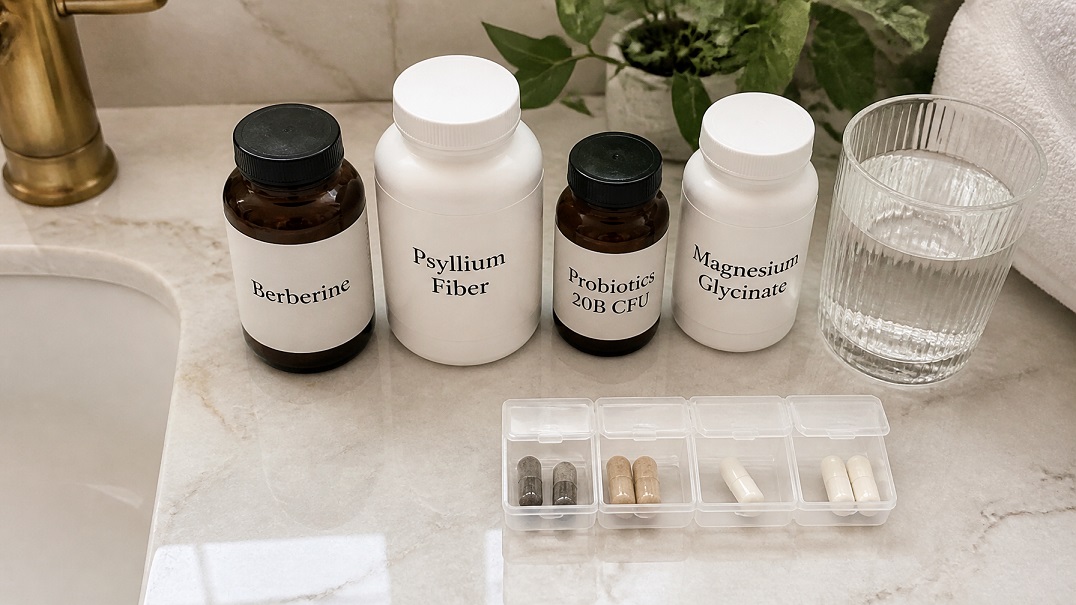
Walk through the supplement aisle — physical or digital — and you’ll find two distinct product philosophies. On one side are single-ingredient products: berberine HCl 500 mg, psyllium husk fiber, magnesium glycinate. On the other are multi-ingredient formulas with names like “GLP-1 Activator Complex” or “Metabolic Support Blend” — products that combine five, eight, or twelve ingredients into a single capsule. The multi-ingredient products often look more sophisticated and frequently cost more. The question is whether they’re actually better for natural GLP-1 support — or whether they’re trading clarity for marketing appeal.
What a Proprietary Blend Actually Is
A proprietary blend is a multi-ingredient formulation where the manufacturer lists all the ingredients together under a single total weight, without disclosing the individual amounts of each component. On a supplement label, it might read: “Metabolic GLP-1 Support Blend 850 mg: berberine HCl, chromium picolinate, cinnamon extract, alpha-lipoic acid, green tea extract.”
You know what’s in it. You don’t know how much of any individual ingredient is present. That 850 mg total could be 700 mg berberine and 150 mg divided among the other four. Or it could be 100 mg berberine and 750 mg of the cheaper ingredients. The label doesn’t tell you, and there’s no regulatory requirement that it does.
Manufacturers offer two justifications for proprietary blends. The first is legitimate: they want to protect their specific formula from being replicated by competitors. The second is less defensible: hiding individual ingredient amounts allows sub-therapeutic doses of expensive, effective ingredients to be obscured behind impressive ingredient lists. The consumer sees eight promising ingredients and imagines synergistic benefit; the reality may be that only one or two are present in meaningful amounts.
Why Proprietary Blends Are a Specific Problem for GLP-1 Supplements
For many supplement categories, sub-therapeutic dosing is an inconvenience — you might get modest benefit instead of optimal benefit. For GLP-1 supporting supplements, it’s a more significant problem because the key ingredients have dose-dependent effects that require reaching studied thresholds to produce meaningful outcomes.
Berberine’s clinical evidence was established at 1,500 mg/day in divided doses. A product listing berberine in a 600 mg proprietary blend alongside five other ingredients almost certainly cannot contain a therapeutic berberine dose — there’s not enough room in 600 mg total for berberine alone to reach 500 mg per serving (the minimum per-dose threshold), let alone leave space for the other listed ingredients. Yet the product can legally claim to contain berberine and reference berberine clinical trial results in its marketing.
The same logic applies to EGCG from green tea extract (evidence-supported target: 200–400 mg EGCG daily), psyllium fiber (10–15g daily), and magnesium glycinate (200–400 mg daily). Each of these ingredients requires a meaningful dose to produce the GLP-1-adjacent benefits attributed to them. In a proprietary blend covering all four at a combined 1,000 mg total, none can be present at therapeutic levels.
When Proprietary Blends Can Be Legitimate
Not all proprietary blends are equally problematic. Several scenarios exist where a multi-ingredient formula with undisclosed individual amounts is less concerning.
When the total blend weight is large enough to contain all key ingredients at meaningful doses. If a formula lists three ingredients in a 3,000 mg total blend, there’s theoretically enough room for each to be present at therapeutic amounts — though you still can’t verify this without disclosure. A small total blend weight with many ingredients is always suspicious; a large total with few ingredients is less so.
When the manufacturer discloses amounts despite using the “blend” terminology. Some manufacturers call their formula a “blend” for branding reasons while still listing individual ingredient amounts in the Supplement Facts panel. This is technically not a proprietary blend in the regulatory sense — it’s just a named formula with full disclosure. Read the fine print.
When the formula is for ingredients where synergy at lower individual doses is plausible and studied. Some combinations work better together than separately — for example, curcumin and piperine together, where piperine dramatically improves curcumin absorption and both need to be present. If a formula combines ingredients where synergy is mechanistically sound and the combined dose at lower individual amounts still produces meaningful effect, the proprietary blend concern is reduced.
When you can verify through the manufacturer. Reputable companies with genuine proprietary formulas will sometimes disclose individual dosing to serious inquirers — particularly those with medical needs or concerns. A manufacturer that refuses to confirm whether berberine is present at 500 mg per serving or 50 mg per serving is likely hiding the answer. One that confirms therapeutic dosing of the key active ingredients, even without printing it on the label, is more trustworthy.
The Case for Single-Ingredient Supplements
Single-ingredient products have a straightforward advantage: complete transparency. You know exactly what you’re getting, at what dose, in what form. You can compare it directly to the clinical trial evidence. You can adjust the dose independently. You can identify which ingredient is producing which effect. And you can build your own stack — combining single-ingredient products — at doses that match the research rather than whatever a blend’s manufacturer chose.
For GLP-1 support specifically, the most evidence-backed ingredients are berberine, soluble fiber, magnesium, and omega-3 fatty acids. Each has a well-established evidence-supported dose. Each is available as a high-quality single-ingredient product. Taking them separately — berberine HCl 500 mg with each meal, magnesium glycinate 300 mg at bedtime, omega-3s 2–3g with dinner, psyllium husk 5–10g before meals — costs roughly the same or less than a premium proprietary blend and provides confident dosing of each component at studied levels.
The main argument against building your own stack is inconvenience: multiple bottles, multiple capsules per day, more to keep track of. This is a real friction point for some people. If the choice is between a reasonably formulated multi-ingredient product taken consistently and a better-in-theory single-ingredient stack that sits unused, the multi-ingredient product wins by virtue of actually being taken. Adherence is the highest-leverage variable in any supplement strategy.
How to Evaluate a Multi-Ingredient GLP-1 Formula
If you prefer a multi-ingredient product over building your own stack, the evaluation framework is more demanding than for single-ingredient products — but workable. Run through these questions:
Is the Total Blend Weight Plausible for the Claims?
If a formula claims to contain berberine HCl, EGCG, chromium, cinnamon extract, and alpha-lipoic acid in a 500 mg proprietary blend, the math doesn’t work for meaningful berberine dosing. Berberine HCl alone requires 500 mg per serving to reach the minimum therapeutic single dose. A 500 mg blend cannot simultaneously contain therapeutic berberine and four other ingredients. This is the most basic screening question — does the total blend weight make therapeutic dosing of the primary active ingredient physically possible?
What Is Listed First in the Blend?
FDA labeling rules require ingredients within a proprietary blend to be listed in descending order of predominance by weight — the most abundant ingredient listed first. If berberine is listed first in a blend, it’s present in greater quantity than any other listed ingredient. If it’s listed fourth after three cheaper ingredients, it may be present in very small amounts. This ordering provides partial information about relative amounts even when absolute amounts aren’t disclosed.
Does the Product Have Third-Party Testing?
Third-party testing is especially important for proprietary blends because it’s the only independent mechanism for verifying that key ingredients are present at meaningful amounts. A proprietary blend that has passed testing from USP, NSF, or ConsumerLab has at least been independently verified for label accuracy — including that the amounts of active ingredients match what was submitted for testing. Without third-party testing, a proprietary blend provides no independent verification of its actual contents.
Can the Manufacturer Confirm Key Doses?
Contact the manufacturer and ask: “Can you confirm that berberine is present at a minimum of 500 mg per serving in your product?” A confident, specific answer — whether yes or no — tells you something meaningful. Evasive answers, references to “proprietary” information as a reason not to disclose, or claims that the synergistic formula means lower doses are effective without providing evidence — these are red flags. Reputable companies with genuinely effective formulas are typically willing to confirm that key ingredients are present at meaningful amounts, even without printing every individual dose on the label.
Transparently Dosed Multi-Ingredient Formulas: The Best of Both
Some manufacturers have moved toward full transparency in multi-ingredient formulas — disclosing every ingredient amount in the Supplement Facts panel while still marketing the product as a complete GLP-1 or metabolic support formula. These products offer the convenience of a multi-ingredient product without the opacity of a proprietary blend.
A transparently dosed formula listing berberine HCl 500 mg, EGCG 200 mg, chromium picolinate 200 mcg, and cinnamon extract 250 mg per serving tells you exactly what you’re getting and allows direct comparison to the clinical evidence for each component. This is the multi-ingredient format worth considering — it combines convenience with the dosing clarity that GLP-1 supplement evaluation requires.
When evaluating any multi-ingredient product, the distinction between a proprietary blend and a transparently dosed formula is the single most important structural feature to identify. Our article on how to read a supplement label covers where on the label this distinction appears and how to identify it quickly.
The Honest Bottom Line
For GLP-1 support, single-ingredient supplements or transparently dosed multi-ingredient formulas are preferable to proprietary blends in virtually every scenario where dosing precision matters — which, for the evidence-supported GLP-1 ingredients, is essentially always.
Berberine’s clinical evidence depends on reaching 1,500 mg/day. Proprietary blends that cannot contain therapeutic berberine by simple arithmetic are not a functional substitute, regardless of how many other ingredients they include. The same applies to EGCG, psyllium fiber, magnesium, and omega-3s — all have dose-dependent effects that require reaching studied thresholds.
If you’re considering a proprietary blend, apply the plausibility test, check ingredient ordering, demand third-party testing, and contact the manufacturer for dose confirmation on the primary active ingredients. A blend that passes all four of these checks may be a legitimately effective product. One that fails any of them is asking you to spend money on faith rather than evidence — and natural GLP-1 support is a field where the evidence is specific enough to require more than that.