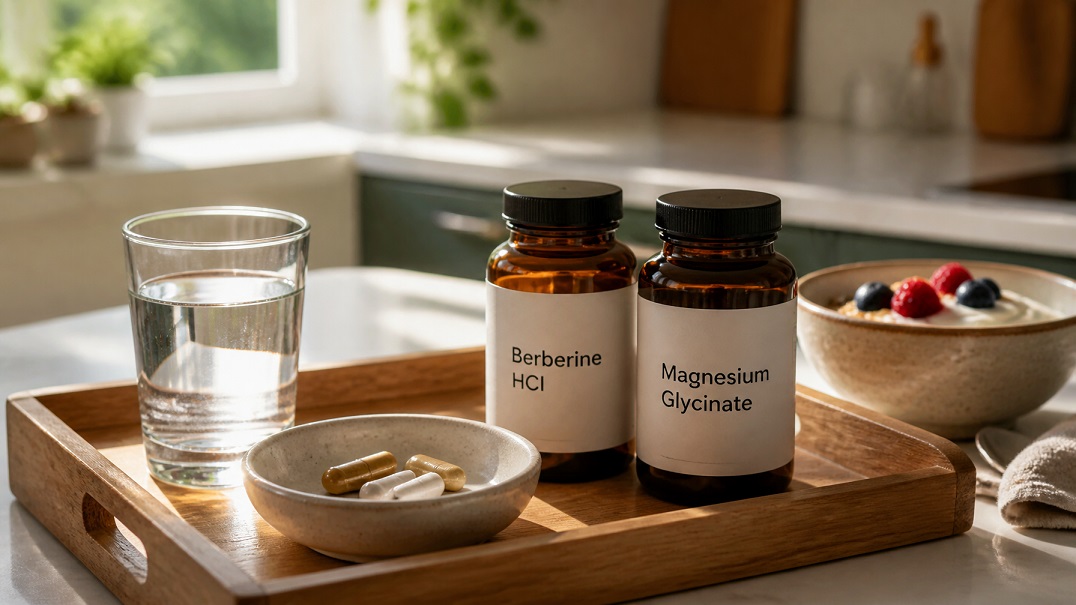
Berberine is the most evidence-backed natural supplement for GLP-1 support, but it doesn’t work in isolation from everything else you might be taking. Some supplements amplify berberine’s effects by targeting complementary mechanisms. Others overlap in ways that may increase side effect risk without adding proportional benefit. And a few combinations raise real safety questions worth knowing before you start.
This article goes deeper than the general stack overview. If berberine is already part of your routine — or you’re planning to make it the foundation of one — here’s a specific, practical guide to what pairs well with it, what to be cautious about, and how to sequence additions intelligently.
Why Berberine Is the Right Starting Point
Before getting into combinations, it’s worth being clear on what berberine actually does, because its mechanisms determine which pairings make the most sense.
Berberine works primarily through three pathways relevant to GLP-1 support. It activates AMPK (adenosine monophosphate-activated protein kinase), a cellular energy sensor that improves insulin sensitivity and glucose uptake in muscle and liver cells. It inhibits DPP-4, the enzyme that normally breaks down GLP-1 within one to two minutes of release, extending GLP-1’s active window. And it positively reshapes the gut microbiome, increasing populations of bacteria that produce the short-chain fatty acids (SCFAs) that stimulate L-cells to release more GLP-1.
That’s three mechanisms: insulin sensitization, DPP-4 inhibition, and microbiome support. The most useful additions to berberine are those that cover mechanisms it doesn’t — particularly direct L-cell stimulation and inflammation reduction.
A Quick Note on Berberine’s Bioavailability
Berberine has notoriously poor oral bioavailability — less than 5% of a standard dose reaches systemic circulation. This sounds like a problem, but it’s partly why berberine works so well in the gut: most of it stays there, where it can act on gut bacteria, L-cells, and intestinal tissue directly. Some combinations can affect how berberine is absorbed, which is worth keeping in mind. More on that below.
Combinations That Work Well Together
Berberine + Psyllium Husk
This is probably the most synergistic pairing in the natural GLP-1 space. Psyllium husk directly stimulates L-cells through SCFA production — a mechanism berberine influences indirectly through the microbiome but doesn’t trigger as immediately as fiber does. Psyllium also slows gastric emptying, which keeps nutrients in contact with L-cells longer and blunts post-meal glucose spikes.
The practical consideration: take psyllium and berberine at slightly different times within the same meal. Psyllium forms a gel in the gut that can bind to other compounds and potentially reduce their absorption. Taking berberine 15 to 20 minutes before the psyllium — or at the start of a meal while psyllium is taken mid-meal with water — is a simple way to minimize any absorption interference. The evidence that this is a significant problem in practice is limited, but it’s an easy precaution.
Berberine + Probiotics
Berberine and probiotics both work on the gut microbiome, but they do so differently. Berberine selectively suppresses certain harmful bacterial strains while promoting beneficial ones. Probiotic supplements directly introduce beneficial strains like Lactobacillus reuteri, L. rhamnosus, and Bifidobacterium longum that produce SCFAs and support GLP-1 secretion.
There’s a theoretical concern sometimes raised that berberine’s antimicrobial properties might reduce the survival of probiotic strains. In practice, the research doesn’t support this being a major issue — berberine’s selective antimicrobial activity primarily targets pathogenic bacteria, and the probiotic strains with the best GLP-1 evidence appear relatively resistant to its effects. Still, separating them by a few hours (berberine with meals, probiotics at breakfast or before bed) is a reasonable precaution if you want to be careful.
Berberine + Green Tea Extract (EGCG)
EGCG is a DPP-4 inhibitor, just like berberine — but through a different binding mechanism. Combining two DPP-4 inhibitors working through distinct pathways may produce a more sustained inhibition effect than either alone. Think of it as blocking the same door from two different angles.
EGCG also has independent effects on fat oxidation and mild appetite suppression that complement berberine’s metabolic actions without significant overlap. At the doses used in most research (200 to 400 mg EGCG per day alongside standard berberine doses), the combination appears safe and well-tolerated. The main caution is that high-dose EGCG on an empty stomach can cause nausea, so take it with food — ideally the same meal as berberine.
Berberine + Omega-3 Fatty Acids
This is a complementary pairing rather than a synergistic one in the strict sense. Omega-3s stimulate GLP-1 release through the GPR120 receptor on L-cells and reduce the chronic inflammation that can blunt GLP-1 signaling over time. Berberine doesn’t work through GPR120, so omega-3s are genuinely adding a new mechanism rather than doubling up on an existing one.
There are also no known negative interactions between berberine and fish oil. Both can mildly affect platelet aggregation (blood clotting behavior) at high doses, so people taking anticoagulants like warfarin should flag both to their prescriber — but for most people this is not a concern at standard supplemental doses.
Berberine + Magnesium
Magnesium’s role here is supportive rather than directly additive. Magnesium deficiency impairs insulin signaling and glucose metabolism at the cellular level — and correcting that deficiency creates a better environment for berberine’s AMPK-activating effects to take hold. If you’re deficient (and given that an estimated 45 to 68% of Americans fall short of the RDA, there’s a reasonable chance you are), adding magnesium glycinate to berberine is like fixing the road before driving on it.
Magnesium is best taken in the evening — it has mild relaxation effects and is well-tolerated before bed. This timing also separates it from berberine’s three-times-daily meal dosing without any deliberate effort.
Combinations to Approach with Caution
Berberine + Chromium + Cinnamon + Inositol
Each of these supplements has individual evidence for blood sugar support. But stacking all of them together creates a meaningful cumulative blood-sugar-lowering effect that can become problematic, particularly for people who are not diabetic or who are already eating a lower-carbohydrate diet.
Chromium, cinnamon extract, and inositol are all situational supplements — appropriate for specific people in specific situations, not universal additions. Taking all of them alongside berberine without a clear rationale is adding complexity and cost without proportional benefit, and it raises the risk of blood sugar dipping lower than intended, particularly after meals.
If you want to add one of these to berberine, that’s reasonable with appropriate care. Stacking all four alongside berberine — especially without medical supervision — is not a strategy this site recommends.
Berberine + Prescription Diabetes Medications
This is the most important caution in this article. Berberine produces blood-sugar-lowering effects that are comparable in some studies to metformin. Adding berberine on top of metformin, sulfonylureas, insulin, or GLP-1 receptor agonists like semaglutide creates a real risk of hypoglycemia — blood sugar dropping too low. Symptoms include shakiness, confusion, sweating, and in severe cases, loss of consciousness.
This doesn’t mean the combination is always off-limits — some practitioners use berberine alongside metformin intentionally, with monitoring. But it should never happen without your prescribing doctor’s knowledge and a plan for checking blood glucose regularly. If you take any diabetes medication, this conversation has to happen before you start berberine. See Berberine vs. Metformin: How Do They Compare? for more detail on how these two interact.
Sequencing: How to Add Supplements to Berberine Over Time
One of the most common mistakes people make is starting several new supplements at once. If something goes wrong — a side effect, an interaction, an unexpected response — you have no idea which addition caused it. Sequencing intelligently protects you and gives you better information.
A practical sequence for building a berberine-centered stack looks like this. In weeks one and two, start with berberine alone at 500 mg once daily with your largest meal — not the full three-times-daily dose yet. This gives your gut time to adjust. Most people tolerate berberine well, but starting low reduces early digestive discomfort.
In weeks three and four, increase to 500 mg twice daily and add psyllium husk at 5 grams once daily before a meal. In weeks five and six, increase berberine to the full 500 mg three times daily if tolerated, and increase psyllium to twice daily. In weeks seven and eight, add your probiotic. From week nine onward, consider omega-3s and EGCG based on your goals and budget.
How Long Before You See Results
Berberine’s effects on post-meal blood sugar can appear within the first few weeks. Meaningful changes in fasting blood glucose and HbA1c typically take eight to twelve weeks. Weight changes, if they occur, are usually gradual and modest — expect 1 to 2 kg over the first two to three months, not rapid loss.
Patience matters here. Natural GLP-1 support builds cumulatively. The microbiome changes that drive sustained GLP-1 production take weeks to months to develop. Don’t draw conclusions at week three; evaluate honestly at week twelve.
Practical Takeaway: Build Outward from Berberine
Berberine earns its place as the foundation of a natural GLP-1 supplement plan. The best additions extend its effects into mechanisms it doesn’t cover — direct L-cell stimulation through fiber, inflammation reduction through omega-3s, and microbiome seeding through probiotics — rather than stacking more of the same.
Keep it simple, sequence deliberately, and be especially careful if you take any prescription medication that affects blood sugar. A stack of three to five well-chosen supplements, introduced gradually and given adequate time to work, will outperform a disorganized collection of ten. For a complete overview of all the supplements in this category and how they compare, see Natural GLP-1 Supplements: What Works, What Doesn’t, and What’s Overhyped.