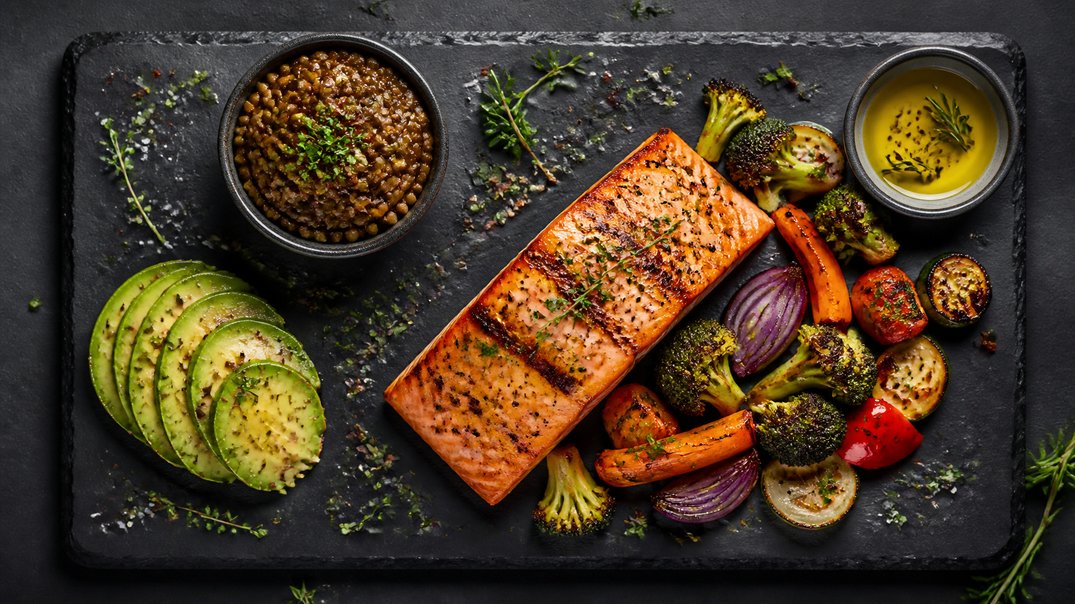
Fat is often treated as a secondary consideration in metabolic health discussions — something to moderate or avoid rather than actively choose for its benefits. But when it comes to GLP-1, the type of fat you eat matters considerably. Certain fats directly stimulate GLP-1 release through a specific receptor pathway. Others appear to blunt GLP-1 signaling over time. The difference isn’t about how much fat you eat — it’s almost entirely about which kind.
This article covers the fat-GLP-1 connection in practical terms: the mechanism behind how fat triggers GLP-1, which specific fats and foods activate that mechanism most effectively, and which dietary fat patterns consistently show up in research as harmful to metabolic function and GLP-1 activity.
How Fat Triggers GLP-1: The GPR120 Pathway
L-cells in the small intestine and colon are equipped with a receptor called GPR120 (also known as free fatty acid receptor 4, or FFAR4). When long-chain fatty acids come into contact with GPR120 on L-cells during digestion, the receptor signals the L-cell to release GLP-1.
This is the same receptor activated by EPA and DHA from fish oil — which is why omega-3 supplementation has direct GLP-1 effects. But dietary fats consumed as food activate this pathway too, and the degree of activation depends heavily on the type of fatty acid.
Long-chain monounsaturated fatty acids (like oleic acid in olive oil) and long-chain polyunsaturated fatty acids (like the omega-3s EPA and DHA in fatty fish, and the omega-6 linoleic acid in nuts and seeds) are strong GPR120 activators. Saturated fatty acids activate GPR120 more weakly and inconsistently. Trans fats appear to impair GPR120 signaling rather than stimulate it.
Fat also stimulates GLP-1 through a second mechanism: it slows gastric emptying — the rate at which the stomach releases its contents into the small intestine. Slower gastric emptying means nutrients stay in contact with L-cells longer, producing a more sustained GLP-1 signal from the whole meal. This effect is shared across fat types, though it’s generally proportional to total fat content rather than fat type specifically.
Fats That Support GLP-1: What to Eat
Extra Virgin Olive Oil
Extra virgin olive oil is the single most GLP-1-supportive fat for most people, for several overlapping reasons. Its primary fatty acid — oleic acid, a long-chain monounsaturated fat — is a strong GPR120 activator. Its polyphenol content (particularly oleocanthal and oleuropein) has anti-inflammatory properties that reduce the chronic inflammation associated with blunted GLP-1 signaling over time. And the Mediterranean dietary pattern, which centers olive oil as its primary fat, consistently shows improved insulin sensitivity and metabolic outcomes in large epidemiological and intervention studies.
The “extra virgin” designation matters here. Refined olive oil has much lower polyphenol content — the refining process strips most of them out. Cold-pressed extra virgin olive oil retains both the oleic acid and the polyphenols that make it particularly effective for metabolic support.
Using olive oil as the primary cooking fat and dressing oil — rather than seed oils or butter for most applications — is one of the most well-supported dietary shifts for overall metabolic health and GLP-1 support.
Avocados
Avocados are unusual among whole foods in that they provide substantial long-chain monounsaturated fat alongside meaningful soluble fiber — giving them GLP-1 benefits through both the GPR120 fat pathway and the fiber-SCFA pathway simultaneously. Half an avocado delivers roughly 10 to 12 grams of fat (predominantly oleic acid) alongside 5 grams of total fiber including about 2 grams soluble.
Research on avocado consumption and metabolic health shows consistent benefits for post-meal satiety, blood lipids, and insulin sensitivity. A study published in Nutrients found that adding half an avocado to lunch significantly reduced desire to eat in the hours following the meal — an effect consistent with enhanced GLP-1 and PYY signaling. Avocados are one of the few foods where the fat-fiber combination in a single serving reliably activates multiple GLP-1 pathways at once.
Fatty Fish
Salmon, mackerel, sardines, herring, and trout provide EPA and DHA — long-chain omega-3 polyunsaturated fatty acids that are among the most potent GPR120 activators available in food. As covered in the protein discussion, fatty fish also provides complete protein that stimulates L-cells through the amino acid pathway, making it uniquely effective for GLP-1 among protein-fat combination foods.
Two to three servings of fatty fish per week delivers roughly 1,500 to 2,500 mg of combined EPA and DHA per serving — overlapping with the doses used in metabolic research. This is meaningful even for people who also take fish oil supplements, because the food matrix in whole fish may influence how omega-3s are absorbed and utilized differently than isolated supplements.
Nuts and Seeds
Almonds, walnuts, pistachios, chia seeds, flaxseeds, and hemp seeds all provide long-chain fatty acids alongside fiber and protein, creating a compact multi-mechanism GLP-1 stimulus.
Walnuts are worth highlighting specifically. They are one of the few plant foods with meaningful alpha-linolenic acid (ALA) — a plant-based omega-3 that the body partially converts to EPA and DHA. Walnut consumption has been shown to improve gut microbiome composition, increasing SCFA-producing bacteria associated with GLP-1 production. A handful of walnuts (about 30 grams) as a snack is a practical way to add fat-pathway GLP-1 support between meals.
Chia seeds and ground flaxseeds combine soluble fiber with ALA omega-3s, hitting both the SCFA and GPR120 pathways from a small serving. Two tablespoons of chia seeds in yogurt or oatmeal adds roughly 9 grams of fat (predominantly ALA) alongside 5 grams of soluble fiber.
Full-Fat Dairy
Full-fat dairy — particularly yogurt, kefir, and cheese — provides long-chain saturated and monounsaturated fatty acids alongside protein and (in fermented products) live cultures. The GPR120 activation from dairy fat is less potent than from olive oil or fish, but it’s real, and the protein-fat combination in full-fat dairy tends to produce more sustained satiety and GLP-1 responses than low-fat versions.
The broader research on full-fat dairy and metabolic health has shifted meaningfully in recent years. Large observational studies and some intervention trials have found that full-fat dairy consumption is not associated with increased cardiovascular risk and may even be associated with lower rates of type 2 diabetes compared to low-fat dairy. For GLP-1 purposes specifically, the fat content adds a pathway that low-fat versions can’t replicate.
Fats That Undermine GLP-1: What to Limit
Industrial Trans Fats
Trans fats — created by partially hydrogenating vegetable oils — have been largely removed from the food supply in the United States following an FDA ban that took effect in 2020. However, small amounts persist in some processed and fried foods, and imported products may still contain them. Trans fats appear to impair GPR120 receptor function rather than activate it, and their association with inflammation, insulin resistance, and cardiovascular disease makes them actively harmful to the metabolic environment that GLP-1 operates in. Checking ingredient labels for “partially hydrogenated oils” remains a worthwhile habit.
High Saturated Fat from Ultra-Processed Sources
The picture with saturated fat is more nuanced than the old “saturated fat is bad” blanket statement — but context matters enormously. Saturated fat from whole food sources like dairy and unprocessed meat has a different metabolic effect than the saturated fat found in ultra-processed foods, fast food, and packaged snacks.
The concern for GLP-1 specifically is that diets high in saturated fat — particularly from processed sources — are consistently associated with reduced GLP-1 responsiveness, increased gut inflammation, and shifts in the gut microbiome away from SCFA-producing bacteria toward populations associated with worse metabolic outcomes. A diet built around fast food, processed meats, and packaged snack foods is, in effect, a low-GLP-1 diet — not primarily because of the fat but because of the combination of saturated fat, refined carbohydrates, low fiber, and high inflammatory load that characterize these foods together.
The practical takeaway isn’t to eliminate saturated fat but to concentrate it in whole food sources — dairy, eggs, unprocessed meat — where it comes packaged with protein and other nutrients, rather than in processed foods where it comes with refined carbohydrates, additives, and near-zero fiber.
High Omega-6 Vegetable Oils
Corn oil, soybean oil, sunflower oil, and cottonseed oil are high in linoleic acid, an omega-6 polyunsaturated fatty acid. Linoleic acid does activate GPR120, but the issue is context and ratio. Modern Western diets have omega-6 to omega-3 ratios of roughly 15:1 to 20:1, whereas the ratio associated with better metabolic and inflammatory outcomes is closer to 4:1.
High omega-6 intake without adequate omega-3 counterbalance promotes the production of pro-inflammatory eicosanoids that impair the metabolic environment GLP-1 operates in. These oils don’t directly suppress GLP-1, but they contribute to a pro-inflammatory state that blunts GLP-1’s downstream effects over time. Replacing seed oils with extra virgin olive oil for most cooking applications and ensuring adequate omega-3 intake through fatty fish or supplements addresses this imbalance.
Practical Takeaway: Build Meals Around GLP-1-Supportive Fats
The dietary fat pattern most consistently associated with GLP-1 support and overall metabolic health is one built around extra virgin olive oil, avocados, fatty fish, and nuts — the same fat profile that characterizes the Mediterranean diet, which has the strongest evidence base of any dietary pattern for metabolic health outcomes.
In practical terms: use extra virgin olive oil as your default cooking and dressing fat. Eat fatty fish two to three times per week. Add half an avocado to meals that benefit from it. Snack on a small handful of walnuts or almonds rather than processed snacks. Add chia or ground flax to oatmeal and yogurt. These shifts don’t require tracking or eliminating anything — they’re substitutions that move fat intake toward the types that support GLP-1 and away from those that don’t.