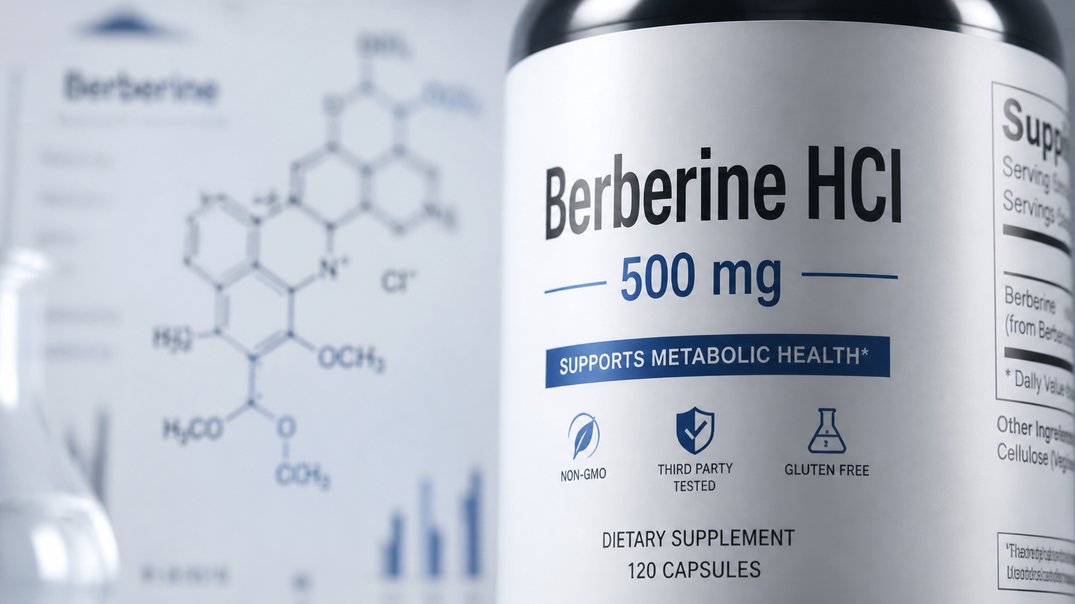
Berberine gets most of its attention as a blood sugar supplement, and the evidence there is solid. But women researching berberine often want to know about something broader: does it affect hormones? The answer is yes — and in ways that are genuinely relevant to women’s health, not just metabolic markers. Berberine influences insulin, androgens, estrogen metabolism, and potentially thyroid function. Some of those effects are clearly beneficial. Others require awareness, especially if you’re managing a specific hormonal condition or taking medications. Here’s what the research actually shows.
How Berberine Affects Insulin — and Why That’s Hormonal
Insulin is a hormone, and it’s the one berberine affects most directly and most powerfully. Berberine activates AMPK (adenosine monophosphate-activated protein kinase), a cellular enzyme that acts as a metabolic master switch. When AMPK is activated, cells become more sensitive to insulin — they respond to it properly rather than requiring ever-larger amounts to do the same job.
This matters for hormonal balance because insulin doesn’t act in isolation. Chronically elevated insulin — the hallmark of insulin resistance — signals the ovaries to produce more androgens like testosterone. It also suppresses sex hormone-binding globulin (SHBG), a protein that binds testosterone and keeps it inactive. Less SHBG means more free, active testosterone circulating in the blood. For women, that translates to acne, excess hair growth, irregular cycles, and the other androgen-excess symptoms common in PCOS.
By improving insulin sensitivity, berberine addresses the root cause of this androgen excess — not the symptoms directly, but the hormonal driver behind them. This is why berberine trials in women with PCOS consistently show reductions in testosterone alongside improvements in blood sugar and insulin.
Berberine and Androgens in Women
The androgen-lowering effect of berberine in women is one of the better-documented findings in the research. Multiple trials in women with PCOS have measured free testosterone, total testosterone, and the LH/FSH ratio (a hormonal marker of androgen excess) before and after berberine supplementation.
The results are consistent: berberine reduces androgen levels, improves the LH/FSH ratio, and in some trials restores more normal menstrual cycling. A 2012 randomized controlled trial published in Fertility and Sterility found berberine comparable to metformin — the standard pharmaceutical for PCOS-related androgen excess — across most hormonal markers over six months.
This doesn’t mean berberine is a treatment for hyperandrogenism (excess androgens) broadly. Its effect is specifically through the insulin pathway. Women with elevated testosterone from causes other than insulin resistance — certain adrenal conditions, for example — would not expect the same results. The mechanism matters for understanding who is most likely to benefit.
What This Means for PCOS Symptoms
Because berberine lowers androgens through insulin reduction rather than directly blocking androgen production or receptors, the timeline is slower than drugs that work at the androgen level directly. Hormonal shifts take months to become apparent. Women using berberine for PCOS-related symptoms like acne or excess hair growth should expect improvements to emerge gradually over three to six months, not weeks, and may be more pronounced in women whose androgen excess is clearly driven by insulin resistance.
For a full picture of berberine’s evidence in PCOS specifically, our article on berberine for PCOS: what the research actually shows covers the trial data in detail.
Berberine and Estrogen Metabolism
The relationship between berberine and estrogen is more complex and less well-established than its effects on insulin and androgens. A few mechanisms are worth understanding.
Berberine appears to inhibit certain enzymes involved in estrogen synthesis, including aromatase — the enzyme that converts androgens into estrogens. In theory, this could reduce estrogen levels slightly. Most of the aromatase inhibition data comes from cell and animal studies, and the practical significance in healthy women taking standard doses is unclear. It hasn’t been shown to produce clinically meaningful estrogen reduction in human trials at typical supplemental doses.
Berberine also influences the gut microbiome, which plays an active role in estrogen metabolism through a collection of gut bacteria called the estrobolome. These bacteria produce an enzyme called beta-glucuronidase that affects how estrogen is recycled or excreted. Berberine’s effects on gut bacteria composition could theoretically influence this pathway, though direct human research on berberine and the estrobolome is limited.
The practical takeaway is that berberine’s effects on estrogen are probably modest at standard doses for most women, but women with estrogen-sensitive conditions — estrogen receptor-positive breast cancer history, for example — should discuss berberine use with their oncologist before starting.
Berberine and Thyroid Function
This is the area where the most caution is warranted. Some research — primarily from animal studies and a smaller number of human investigations — suggests berberine may reduce thyroid hormone levels, specifically T3 and T4, by inhibiting enzymes involved in thyroid hormone synthesis and by reducing TSH (thyroid-stimulating hormone) receptor sensitivity.
A study in humans with hyperthyroidism (overactive thyroid) found berberine helpful for reducing thyroid hormone levels — which in that context is the desired effect. But for women with hypothyroidism (underactive thyroid) already managing low thyroid function, berberine could theoretically make thyroid status harder to manage.
The evidence here is not strong enough to say berberine definitely suppresses thyroid function in healthy women at normal doses. But women who have hypothyroidism, are on thyroid medication like levothyroxine, or have subclinical thyroid issues should have their thyroid levels monitored if they start berberine — and should flag it with their prescribing doctor, since berberine may also affect how thyroid medications are absorbed or metabolized.
Berberine and Cortisol
Cortisol — the primary stress hormone — connects to berberine’s effects through the insulin pathway. Elevated cortisol raises blood sugar (by signaling the liver to release glucose) and worsens insulin resistance. Berberine’s insulin-sensitizing effects may partially counteract cortisol’s metabolic impact, which is why some women notice improved energy and reduced reactive hunger when using berberine during high-stress periods.
There isn’t strong direct evidence that berberine lowers cortisol itself. What it appears to do is blunt some of cortisol’s downstream metabolic consequences — the blood sugar spikes, the insulin surges, the fat storage promotion — rather than addressing the stress response at its source. Managing chronic stress through sleep, movement, and other lifestyle strategies remains essential and isn’t something berberine replaces. Our article on how to lower cortisol to support GLP-1 covers the lifestyle side of this in detail.
Drug Interactions Women Should Know About
Berberine inhibits several liver enzymes — particularly CYP3A4 and CYP2D6 — that metabolize a wide range of medications. This means berberine can raise blood levels of drugs that rely on these enzymes for clearance, potentially increasing their effects or side effects.
Women should be especially attentive to interactions with:
- Oral contraceptives: Berberine may affect how hormonal birth control is metabolized, though the clinical significance of this interaction in humans is not well quantified. If you rely on oral contraceptives for contraception or hormonal management, flag berberine use with your prescribing doctor.
- Metformin: Both lower blood sugar through overlapping mechanisms. The combination can produce additive blood-sugar-lowering effects that require monitoring.
- Levothyroxine (thyroid medication): As noted above, berberine may affect thyroid hormone levels and potentially thyroid medication absorption if taken at the same time. Separate dosing by at least two hours and monitor thyroid levels.
- Cyclosporine and other immunosuppressants: Berberine can significantly raise blood levels of cyclosporine via CYP3A4 inhibition, which is clinically significant. Anyone on immunosuppressive therapy should avoid berberine without explicit medical guidance.
This list is not exhaustive. If you take any prescription medication regularly, a conversation with your pharmacist about berberine interactions is worth having before you start.
Pregnancy and Breastfeeding
Berberine should not be used during pregnancy. It crosses the placental barrier, and animal studies raise concerns about fetal development. It is also not recommended during breastfeeding, as berberine can pass into breast milk. Women who are pregnant, trying to conceive, or breastfeeding should not take berberine. This is one of the clearest safety lines in the berberine literature and should not be ignored based on anecdotal reassurances found online.
How to Use Berberine Thoughtfully for Hormonal Support
For most women using berberine to support insulin sensitivity and hormonal balance — particularly in the context of PCOS, perimenopausal metabolic shifts, or insulin-driven androgen excess — the evidence is genuinely encouraging and the safety profile is reasonable when used at standard doses without contraindicated medications.
The standard dose is 500 mg three times daily with meals. Starting at a lower dose — 500 mg once daily — and building up over two to three weeks reduces the digestive side effects (bloating, loose stools) that are the most common complaint. Cycling berberine — eight to twelve weeks on, two to four weeks off — is sometimes recommended to prevent tolerance, though the evidence for this practice is limited. It’s more a precautionary convention than a proven necessity.
Track hormonal markers with bloodwork where possible — fasting insulin, free testosterone, SHBG, and thyroid panel if relevant. These give you objective data on whether berberine is producing the hormonal effects you’re aiming for, rather than relying solely on subjective symptoms. If you’re working with a physician on a hormonal condition, loop them in before adding berberine to your protocol — it’s a supplement that earns its place in a monitored, evidence-informed approach rather than as casual self-experimentation. Our broader guide on berberine side effects and safety covers what to watch for in more detail.